Humans have a tendency to focus on the negative effects of stress on health and wellbeing. While a certainly necessary perspective, researchers have turned their attention to the possible positive outcomes that can be derived through adverse and stressful events. Numerous scientific fields highlight that stress can be a powerful stimulus for growth and resilience across various aspects of life. For example, hormesis, a concept widely recognised in biology, demonstrates how low doses of harmful substances can trigger beneficial adaptive responses in organisms. This paradoxical effect means that while high doses of a harmful agent can be detrimental, low doses may actually stimulate repair mechanisms and improve overall cellular function.
We also see this phenomenon in exercise physiology, which outlines how moderate physical stress from activities like regular exercise can enhance health and fitness by stimulating the body to adapt and strengthen. For example, muscle fibres must be broken down during exercise before they can repair and grow back stronger, demonstrating how controlled stress leads to positive adaptations.

The field of psychology has also recognised this phenomenon. Terms such as stress-related growth, post-traumatic growth, and adversarial growth can now be found in the literature, highlighting how individuals may experience psychological growth after navigating challenging situations. Psychological studies investigating this phenomenon have reported various psychosocial (e.g., improved coping skills), affective (e.g., increased feelings of pleasure), spiritual (e.g., a deeper sense of purpose), personal (e.g., heightened self-esteem), and health-related (e.g., better physical fitness) outcomes following stressful events across various life contexts [1]. For example, in sport, athletes who have faced setbacks or challenging competitions often experience psychological growth, such as increased resilience, improved focus under pressure, and a heightened ability to manage stress effectively [2].
One of the paradoxes of human psychology is that being vulnerable…to pressure and adversity may be needed to later develop the resilience necessary for high performance…Put another way, in order to withstand and thrive on the highest levels of pressure, individuals may first need to succumb to adversity to subsequently benefit from the psychological and behavioural changes that only this level of trauma can bring [3].
When I talk about growth, I am referring to a range of positive changes that individuals report following stressful experiences. These changes signify a resilient response to adversity and challenge, where the encounter with stressors leads to meaningful personal development. However, it’s important to acknowledge that stress isn’t always beneficial. It’s well-documented that chronic stress can have detrimental effects on individuals. Understanding this dual nature of stress is crucial in appreciating its complexities and impact on psychological well-being.
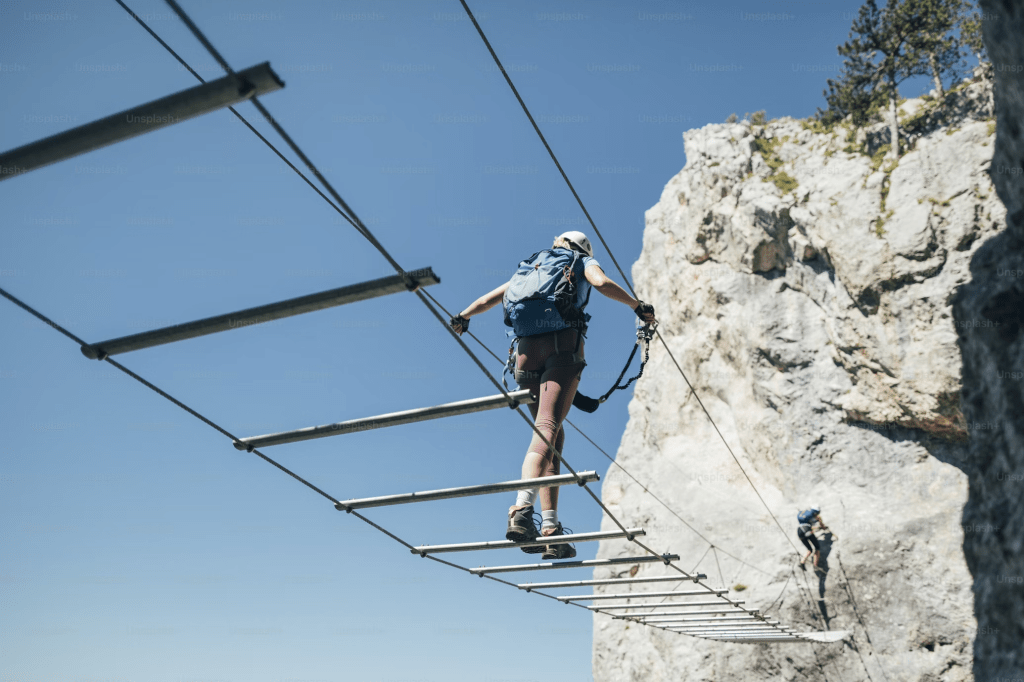
A growing body of evidence suggests that engaging in recreational physical challenges, which provide controlled exposure to acute stressors, can have a positive impact on psychological growth [4]. The theoretical explanation is that when people successfully navigate challenging circumstances by stepping outside their comfort zones, they often experience a heightened sense of self-confidence and resilience. This is because they are provided with an authentic experience of success and mastery, which renowned psychologist Albert Bandura identified to be the most powerful means of creating a strong, resilient sense of self. By overcoming these controlled stressors, individuals develop a robust belief in their ability to handle future challenges, contributing significantly to their overall health and well-being. Additionally, there are growing neuroscientific explanations for the benefits of challenging experiences, such as promoting neuroplastic adaptation [5]. However, I am no neuroscientist so will not delve any deeper.

However, robust scientific evidence supporting this hypothesis is still limited. We recently published a randomized controlled trial [6], regarded as the gold standard for evaluating the efficacy of interventions, on the psychological impact of challenging experiences. Participants were randomly assigned to either a high ropes challenge course (intervention group) or a control group that continued with their daily activities. Pre- and post-examinations of the participants’ perceptions of self-efficacy revealed a significant increase in the intervention group compared to the control group.
Our findings demonstrate that even brief exposure to experiences that push individuals outside their everyday comfort zones and challenge them both psychologically and physically can significantly enhance their self-confidence. Perhaps most notably, data collected in our published qualitative study [7] indicate that these desirable personal changes are not confined to the specific contexts in which they are gained. Instead, they are transferable and can be applied to improve oneself across different life domains. For example, we found employees were more confident in their abilities to tackle work-related challenges and conflicts. Therefore, these experiences do not merely change a singular moment in time, but rather create a turning point which can begin a process that unfolds over time
In conclusion, while the adverse effects of stress on health and wellbeing are undeniable and well-documented. It is important for us to recognise the potential for positive outcomes that stressful challenging experiences can catalyse. Across multiple scientific disciplines, including biology, exercise physiology, psychology, and neuroscience, evidence supports the concept that controlled exposure to stressors can foster some form of organism growth. My research, in collaboration with The Leadership High, reinforces this notion, demonstrating that challenging experiences can enhance self-efficacy and broader personal development. While more research is needed, initial findings have practical implications for organisations and educational institutions who wish to promote adults’ self-confidence. Findings, particularly, highlight the potential for such programmes to be used as targeted interventions for individuals navigating workplace and academic stressors, mental health challenges, and seeking enhanced performance.
PhD powered by The Leadership High (https://theleadershiphigh.com) and Loughborough University.
References:
[1] Linley, P. A., & Joseph, S. (2004). Positive change following trauma and adversity: A review. Journal of traumatic stress: official publication of the international society for traumatic stress studies, 17(1), 11-21.
[2] Fletcher, D. (2018). Psychological resilience and adversarial growth in sport and performance. In Oxford Research Encyclopaedia of Psychology.
[3] Fletcher, D., & Sarkar, M. (2016). Mental fortitude training: An evidence-based approach to developing psychological resilience for sustained success. Journal of Sport Psychology in Action, 7(3), 135-157.
[4] Tyne, W. P., Fletcher, D., Paine, N. J., & Stevinson, C. (2024). Physical Challenge Interventions and the Development of Transferable Skills for the Workplace: A Systematic Review and Meta-Analysis. Organizational Psychology Review, 20413866241245301.
[5] Hunter, R. G., Gray, J. D., & McEwen, B. S. (2018). The neuroscience of resilience. Journal of the Society for Social Work and Research, 9(2), 305-339.
[6] Tyne, W. P., Fletcher, D., Paine, N. J., & Stevinson, C. (2024). Effects of Outdoor Recreational Physical Challenges on General Self-efficacy: A Randomized Controlled Trial. Psychology of Sport and Exercise, 102693.
[7] Tyne, W. P., Fletcher, D., Paine, N. J., & Stevinson, C. (2024). Employees’ experiences of outdoor adventure training on psychological capital and wellbeing: A mixed methods case study. Journal of Outdoor Recreation and Tourism, 46, 100761.
 William Tyne